
Work in Motriz
The product journey
Move a product question through assumptions, evidence, and checkpoints to an honest recorded decision, from Continue to Proceed to build.
Journey is one of the four product destinations — Dashboard · Journey · Co-founder · Build — and it holds the product's decision trail. The five founder questions sit as nodes on one connected vertical line; every recorded decision hangs off the question it answered, in one shared card grammar. Nothing renders detached from the line, and the Dashboard points here instead of copying it. The trail exists so that six months from now you can read exactly what you decided, when, and on what evidence.
The journey is opt-in
Product guidance is never imposed. A product created from Start from an idea or product question begins on the journey, opening with the co-founder intake conversation. A repository product opts in explicitly: through Continue from a repository when you add it, or later via the Start product journey button on its Dashboard. A plain repository product shows only Dashboard and Build, with no journey prompts anywhere — the coding side of Motriz is a complete product on its own.
Build is driven by the repository, not the journey stage. A journey product with a connected repository keeps its Build destination at every stage — on the journey, building, or stopped. Guidance is never a toll.
Five questions, twelve milestones
The methodology is fixed: five founder questions, each covering one act of the journey, broken into twelve milestones (numbered 0–11). Each milestone has its own question, canonical artifact slots (Idea brief, Problem frame, ICP, Market memo, and so on — see Workspace and artifacts), and explicit evidence criteria.
| Founder question | Act | Milestones |
|---|---|---|
| "What are we really betting on?" | The Bet | 0–3: Starting point, Product thesis, Customer and problem, Landscape and wedge |
| "What must be true?" | Must Be True | 4: Assumptions and test design |
| "What did the market do?" | Market Response | 5: Market response |
| "What is the next best bet?" | Next Bet | 6–8: Strategy, Proportional preparation, Build decision |
| "Is real pull forming?" | Product Pull | 9–11: Launch and activation, Retention and payment, Repeatability |
Mature products do not start from zero. When you record a Continue decision at the Starting point milestone, the journey routes by the maturity recorded in the product's Starting point profile: an idea moves to milestone 1, a prototype skips to 5, active users to 9, paying customers to 10, and retained customers or PMF signals to 11.
On the trail, answered questions collapse to one line each; the current question glows, carries the co-founder's brief note, and offers "Work on this with your co-founder →", which prefills the conversation composer — nothing is ever sent for you. Everything ahead collapses into a single row tagged "ahead — opens as evidence lands".
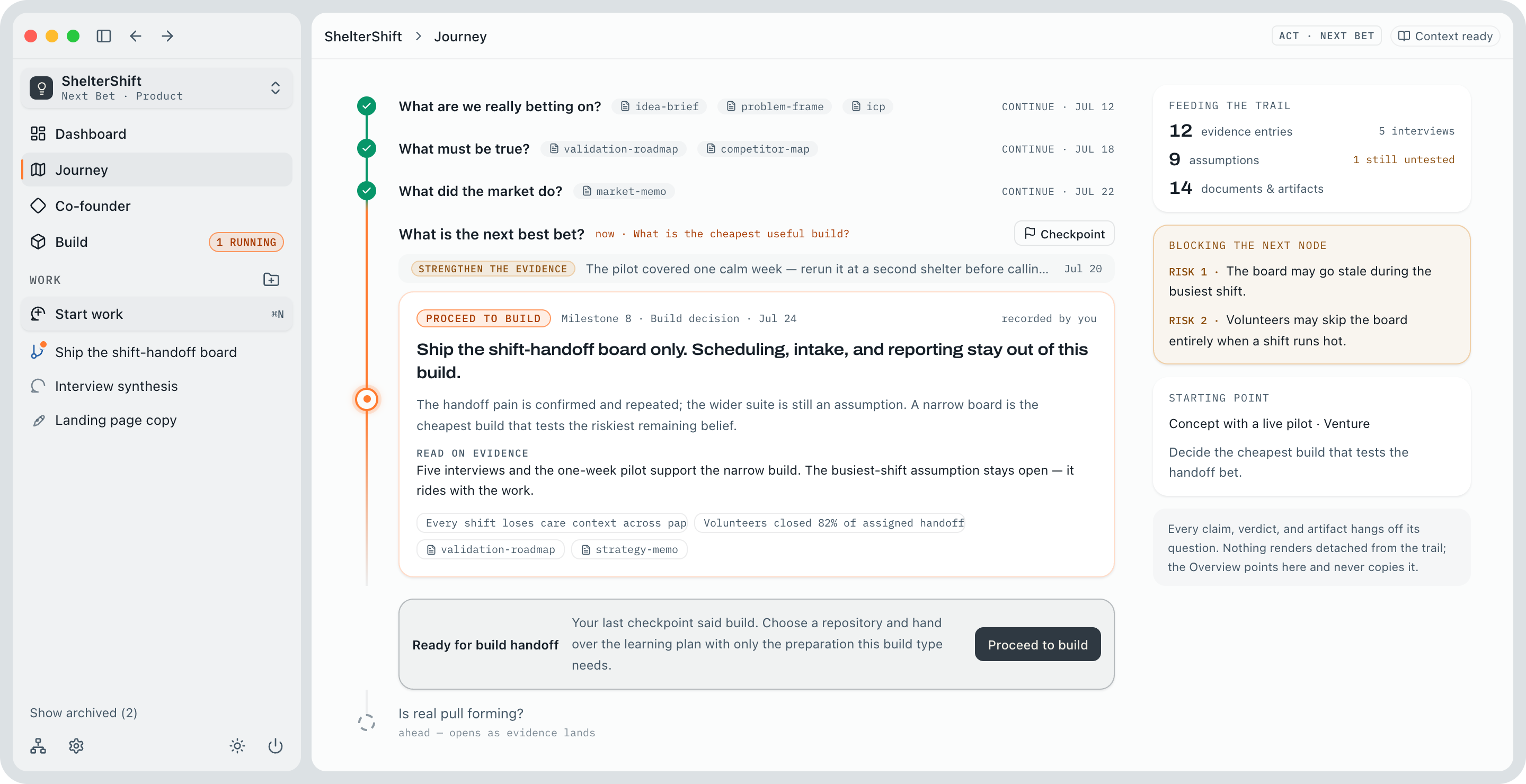
What one decision card shows
Every recorded decision uses the same card grammar. The most recent decision renders in full on its question; every other decision collapses to a one-line row. A full card shows, top to bottom:
- Your decision
The outcome chip — one of the five decision labels — with the mono line "Milestone {n} · {name} · {date}" and "recorded by you".
- Statement and rationale
The decision statement, then your rationale. An overridden co-founder recommendation is stored beside them.
- "Read on evidence"
A qualitative sentence composed from the evidence snapshot taken at the moment you decided — for example, "Two interviews and one web finding support the current direction; one signal is still unconfirmed." Never a meter, score, or percentage.
- Evidence and artifact chips
Up to three evidence claims, plus one chip per captured artifact slot that opens the artifact viewer.
Evidence itself lives in the Evidence workspace tab beside the co-founder conversation: the ledger of what you learned, the ranked assumptions, and the tests with their discovery or validation contracts. Entries land there as the conversation produces them; a milestone is ready for its checkpoint only when every evidence criterion is supported or not applicable — the presence of an artifact never makes it ready.
Checkpoints and scorecards
A checkpoint is exactly what the in-app glossary says: "A moment to decide honestly whether to continue, strengthen the evidence, reshape, or stop." You reach it from the "Checkpoint" button on the current question, from any milestone's detail, or automatically when a co-founder scorecard lands for the current milestone.
Inside the dialog you can press "Ask your co-founder to prepare the call" — or record your own call directly; the subtitle ends "your call, always", and that is literal. The scorecard shows "Your co-founder recommends:" with a verdict, a one-sentence summary, and three lists: Evidence for, Evidence against, and Open risks. The scorecard is advice only — the co-founder never records a decision. If your verdict differs, the dialog says "You're overriding your co-founder's recommendation ({label}) — both positions will be recorded." A rationale is required before "Record decision" enables. Recording a decision clears the pending scorecard — its recommendation now lives on the decision record.
The five decisions
| Decision | What it does |
|---|---|
| Continue | The milestone is answered well enough; the journey moves to the next one (with maturity routing at the Starting point). |
| Strengthen the evidence | At most milestones, moves the journey back to an earlier milestone you choose. At the Build decision (milestone 8), it keeps you there — the signal is not strong enough to decide yet. Recorded on a stopped or building product, it reopens the journey. |
| Reshape | The evidence points toward a different direction: closes the current round and opens the next. |
| Stop on evidence | The evidence says stop. The product stays browsable; that is a useful outcome too. |
| Proceed to build | Available only at the Build decision. You choose a build type (Concierge, Prototype, Technical spike, MVP slice, or Regulated product), and a "Ready for build handoff" banner bridges into Build. |
Reshaping: rounds, and seeds
Reshape means two different things depending on where you record it.
At a checkpoint, Reshape keeps the product and closes a chapter. The dialog says exactly what happens: "This closes Round {n}, not the product. Its artifacts stay browsable as a chapter; your evidence, lessons, and any repository carry into Round {n+1}. Nothing is thrown away." When the co-founder recommends a reshape, it first writes a round retrospective you are asked to read before deciding — reshaping without one is allowed — and the submit button reads "Reshape into Round {n+1}". Closed rounds attach to the top of the trail as collapsed chapters; rounds partition the idea, not the facts.
On a stop record, the "Reshape" button next to a seed spawns a brand-new product: it gets its own co-founder conversation and a pre-filled Idea brief carrying the seed and where it came from, so the new journey starts at the Product thesis instead of starting cold.
The honest stop record
Recording Stop on evidence ends the journey with a record, not a deletion. The trail's end reads "This direction stopped on the evidence. The history stays yours.", with the journey's length in weeks, interview count, and spend when it is known — never a wrong $0. "Seeds worth keeping" lists the pivot-worthy fragments the co-founder flagged, and an "Archive product" toggle tidies it away without destroying anything.
A stopped product's Journey becomes read-only: every decision, artifact, and round stays exactly as recorded. Nothing is deleted. To reopen it, record a Strengthen the evidence decision from its journey — reopening is a recorded decision, never a silent flip.
After launch
The journey does not end at the build. The last three milestones follow the market's actual behavior: Launch and activation ("Are people reaching value?"), Retention and payment ("Do they come back or pay?"), and Repeatability ("Can pull repeat?"). They can be answered with manual aggregate observations; connected analytics sources (Amplitude, PostHog — configured in the Evidence tab) are optional, never prerequisites.
Shipping itself is an observation point, not a success claim. When a work item ships, its record in Build shows "Co-founder · Ready to hear how this landed" with a "Talk it through" button — your answer becomes the observation through the normal conversation, and "Too early to call is a legitimate reading." Motriz never claims a ship it cannot see.